This post may contain affiliate links which means we may receive a commission for purchases made through our recommended links. We will only recommend products or services that we have personally used or that members of our community are currently using. This is of absolutely no cost to you, the company we recommend may pay us a small fee for linking you with them and this helps us with the running costs of our website. Learn more through our Private Policy and Affiliate Disclaimer pages.
The thought you keep pushing down.
You might not say it out loud yet.
You might still be telling people that you are “just tired” or that this term has been “a bit much.” You might still be hoping the holidays will fix it, that a new class will make it easier, or that next year will somehow feel different.
But deep down, there is a thought that keeps coming back.
“I do not think I can do this for another ten years.”
Maybe it hits you on Sunday night when your stomach drops thinking about the week ahead. Maybe it happens when you open your laptop after dinner and realise there are still emails, planning, reports, marking, behaviour notes and parent messages waiting for you. Maybe it happens in the car after school when you sit there for five minutes because you need to gather yourself before walking into your own home.
You are not alone.
So many teachers are quietly asking the same question.
“How do I leave teaching without ruining myself financially?”
Because leaving teaching is not as simple as quitting a job. Teaching becomes part of your identity. It shapes your routines, your friendships, your sense of purpose, your income and even the way you see yourself.
That is why exiting teaching can feel so overwhelming.
You are not just asking, “What job should I do next?”
You are asking:
• Who am I if I am not a teacher?
• How will I replace my income?
• What skills do I actually have outside the classroom?
• Could I really move into a corporate job?
• Could I start my own business?
• What if I leave and regret it?
• What if I stay and nothing changes?
This is where most teachers get stuck.
Not because they lack ability.
Not because they are not employable.
Not because they have nothing to offer.
They get stuck because they cannot see the pathway yet.
And when you cannot see the pathway, the classroom starts to feel like the only option.
Why teachers need a visual exit plan, not just another list of career ideas
If you have already Googled “alternative careers for teachers” or “how to leave teaching,” you have probably seen the same lists over and over again.
- Learning and development
- Instructional design
- HR
- Project management
- Tutoring
- Copywriting
- Virtual assistant work
- Online business
Those lists can be helpful, but they are rarely enough.
Because most teachers do not just need ideas.
They need a plan they can see.
A list of possible jobs does not show you how to get from where you are now to where you want to be. It does not help you work out your finances. It does not help you rebuild your confidence. It does not help you choose between a corporate role and a business. It does not help you believe that a different life is actually possible.
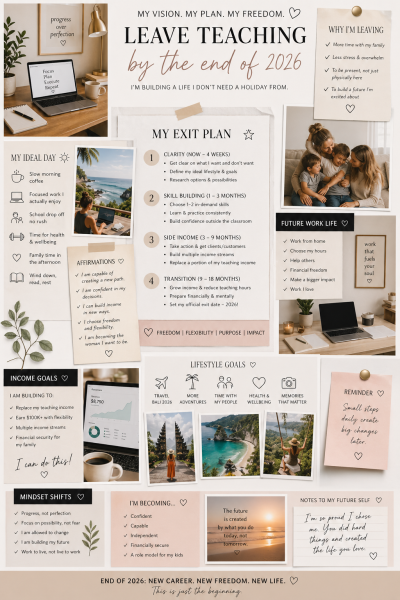
That is why a vision board can be so powerful when it is done properly.
Not a fluffy vision board filled with random quotes and pretty pictures.
A strategic vision board.
A visual exit plan.
A map of the life, work, income and identity you are intentionally building.
When you combine that with ChatGPT, your vision board becomes more than inspiration. It becomes a personalised teacher transition plan.
Why ChatGPT is one of the most powerful tools for leaving teaching in 2026
ChatGPT can help you organise the thoughts that have been swirling around in your head for months or even years.
Instead of sitting with a blank notebook, wondering where to start, you can use ChatGPT to explore your options, ask better questions, map your transition and create a plan that fits your life.
This is especially powerful if you are trying to leave teaching by the end of 2026 because you have enough time to be strategic.
You do not need to panic-quit.
You do not need to resign with no plan.
You do not need to burn everything down and hope for the best.
You can use the next twelve to eighteen months to slowly build your way out.
ChatGPT can help you:
• Identify your transferable teaching skills
• Explore corporate jobs for teachers
• Brainstorm teacher business ideas
• Create a side income plan
• Build a realistic income replacement strategy
• Write your resume and LinkedIn profile
• Create a personalised vision board prompt
• Break your teacher exit strategy into monthly steps
The real power is not just in asking ChatGPT for ideas.
The power is in using it to create clarity.
Clarity about what you want.
Clarity about what you no longer want.
Clarity about what needs to happen next.
Step 1: Start with the life you want, not the job title
Most teachers begin by asking, “What job can I do instead of teaching?”
That is understandable, but it is not the best starting point.
The better question is:
“What kind of life am I trying to create?”
This matters because if you only chase a new job title, you may end up recreating the same stress in a different environment.
You might leave teaching for a corporate job that still drains you. You might start a business that gives you flexibility but no boundaries. You might take on work that looks good from the outside but does not match your actual needs.
Before you choose a pathway, you need to understand the life you are trying to build.
Ask yourself:
What do I want my mornings to feel like?
Do I want to work from home, in an office or a mix of both?
Do I want a steady salary or the freedom to build my own income?
Do I want to work with people, create resources, manage projects, write, train, design, consult or sell services?
How much money do I need to feel safe?
What do I want my family life to look like?
What do I want my stress levels to look like?
This is where your vision board begins.
Not with a random image of a laptop on a beach.
With a clear picture of the life you are choosing.
Step 2: Use ChatGPT to create your personal teacher exit vision
Before you design the visual board, ask ChatGPT to help you develop its strategy.
Use this prompt:
Help me create a personalised plan to leave teaching by the end of 2026.
I want this to become the foundation for a vision board and a step-by-step exit plan.
Ask me questions about:
• My current teaching role
• My workload and stress levels
• My income and financial needs
• My family and lifestyle priorities
• My ideal working week
• Whether I want to move into a corporate job, start a business or explore both
• My fears about leaving teaching
• My transferable skills
• The type of work I feel drawn to
After I answer, create:
• A clear vision for my life after teaching
• A list of possible corporate jobs for teachers
• A list of possible business ideas for teachers
• A realistic twelve to eighteen-month teacher transition plan
• A vision board layout with sections and suggested images
• Affirmations that feel grounded and realistic
• Weekly action steps to help me leave teaching by the end of 2026
The reason this prompt works is that it forces ChatGPT to ask questions before giving advice.
Generic prompts give generic answers.
Personal answers create a personal plan.
Step 3: Choose your pathway, corporate job, business or both
One of the biggest mistakes teachers make when planning to leave teaching is assuming they need to choose one perfect pathway immediately.
You do not.
At the beginning, your job is to explore.
There are usually three strong pathways for teachers who want to leave teaching by the end of 2026.
The first is moving into a corporate job.
The second is starting a business.
The third is building a bridge between the two.
For many teachers, the third option is the safest and most empowering. You might apply for corporate jobs while building a small side business. You might take a learning and development role while growing a tutoring business after hours. You might start freelancing while still teaching to test your skills before making a full leap.
This takes pressure off the decision.
You are not choosing your forever career.
You are choosing your next strategic step.
Step 4: If you want a corporate job, map your teacher skills into corporate language
Teachers often underestimate how valuable their skills are outside the classroom.
You manage groups of people. You communicate complex information clearly. You plan, assess, adapt, present, organise, solve problems and deal with stakeholders daily.
The challenge is not that you lack skills.
The challenge is that your skills are written in “teacher language” instead of “corporate language.”
For example:
Lesson planning becomes learning design.
Classroom management becomes stakeholder management and facilitation.
Assessment becomes data analysis and performance evaluation.
Parent communication becomes client communication.
Curriculum development becomes content development or instructional design.
Leading a year level becomes team coordination or project leadership.
This is exactly where ChatGPT can help.
Use this prompt:
I am a teacher who wants to move into a corporate job by the end of 2026.
Help me translate my teaching skills into corporate language.
My teaching experience includes:
[insert your experience]
Please create:
• A list of transferable skills
• Corporate job titles that match my skills
• Resume bullet points written in corporate language
• LinkedIn headline ideas
• A short professional summary
• Skills I may need to develop over the next six months
Possible corporate jobs for teachers include learning and development consultant, instructional designer, corporate trainer, HR coordinator, project coordinator, education consultant, customer success manager, learning designer, training facilitator and edtech support specialist.
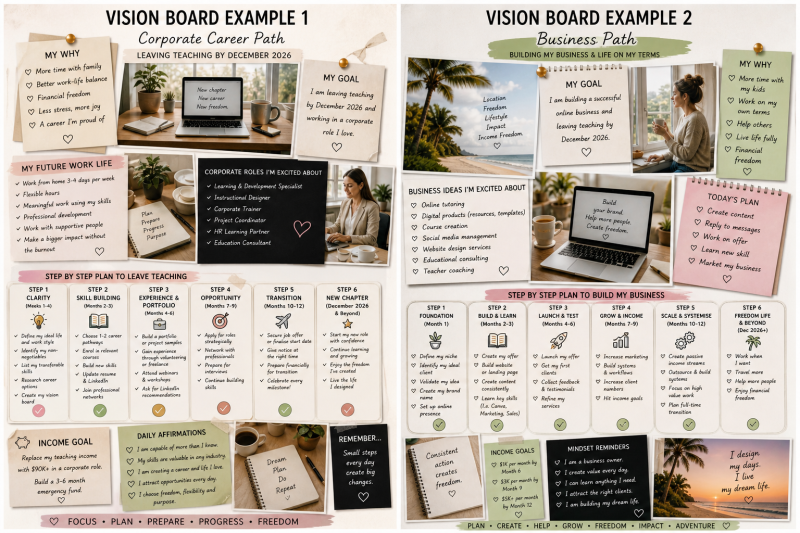
Your vision board should visually reflect this pathway.
Include images of:
• A calm home office
• A laptop with a project dashboard
• A professional LinkedIn profile
• A corporate training session
• A calendar with flexible work blocks
• A salary goal
• A note that says “I use my teaching skills in a new way”
This helps your brain start to see you as someone who can succeed outside the classroom.
Step 5: If you want to start a business, choose a simple income path first
Starting a business after teaching can feel exciting and terrifying.
The freedom is appealing.
The uncertainty is not.
That is why the goal should not be to build a huge business immediately.
The goal is to create your first simple income stream.
Teachers are well-suited to service-based businesses because they already know how to explain, organise, support and deliver outcomes.
Business ideas for teachers include:
• Online tutoring
• Curriculum writing
• Canva template creation
• Social media management
• Website design
• Virtual assistant services
• Teacher coaching
• Online courses
• Educational consulting
• Freelance writing
• Digital products
The best starting point is usually a service that solves a clear problem for a specific group of people.
For example:
A teacher who loves literacy could offer tutoring or reading support.
A teacher who loves design could create Canva templates or websites.
A highly organised teacher could become a virtual assistant or project coordinator.
A teacher who enjoys mentoring could create coaching or support programs.
A teacher who enjoys creating resources could sell digital products or curriculum support materials.
Use this ChatGPT prompt:
I am a teacher who wants to start a business while still teaching so I can eventually leave teaching by the end of 2026.
Help me choose a realistic business idea based on my skills, time and income goals.
Ask me questions about:
• My strengths
• My available time each week
• My income goal
• The type of people I want to help
• Whether I prefer services, digital products, tutoring or coaching
• My current confidence level
• What I already know how to do
Then suggest:
• Three business ideas that suit me
• The easiest one to start
• My first paid offer
• A simple pricing structure
• A ninety-day action plan
• What to include on my vision board
Your vision board should make the business feel real.
Include images of:
• Your first client payment
• A laptop workspace
• A simple offer page
• A calendar with client sessions
• A notebook with your business name
• A monthly income goal
• A note that says “I can create income outside teaching”
The first time you make money outside teaching, everything changes.
Even if it is only $100.
Because suddenly, the idea of leaving teaching is no longer theoretical.
You have proof.
Step 6: Build the vision board sections
A strong teacher exit vision board should have structure.
Think of it as a visual version of your future plan.
Section one: Your exit goal
This is the anchor of the board.
Write one clear statement.
Examples:
I am leaving teaching by December 2026.
I am transitioning from teaching into a corporate role by the end of 2026.
I am building a business that allows me to leave teaching by the end of 2026.
I am creating flexible income outside the classroom.
This section should be bold and central because it reminds you what you are working towards.
Section two: Your why
This is the emotional engine.
Your why is what keeps you going when you are tired, scared or tempted to give up.
Examples:
I want to be present with my family.
I want my evenings back.
I want to stop feeling anxious every Sunday.
I want to feel calm, healthy, and in control again.
I want to build a life I do not need to recover from every school holiday.
This section matters because logic might start the plan, but emotion keeps you moving.
Section three: Your future work life
This section should show what your work could look like after teaching.
For corporate teachers, this might include remote work, professional development, team collaboration, training, project work or a calm desk setup.
For business-minded teachers, this might include clients, digital products, online meetings, creative work, your website or your first income goal.
You want your brain to see the new identity before it fully exists.
Section four: Your income plan
Money is one of the biggest fears teachers have when leaving.
Do not ignore it on your vision board.
Include your financial goals clearly.
Examples:
Replace my teaching income.
Build $1,000 per month in side income.
Secure an $85,000 tp $100,000 corporate role.
Create a three-month emergency fund.
Earn my first $500 outside of teaching.
Apply for five aligned roles per week.
This keeps your vision grounded in reality.
Section five: Your lifestyle vision
This section is where you remind yourself what the work is for.
Examples:
Slow mornings.
Travel.
More time with my children.
Weekends without schoolwork.
Evenings without guilt.
Energy to exercise.
A calmer home life.
A life that feels like mine again.
This is where your vision board becomes emotionally powerful.
Section six: Your identity shift
This is the section most people forget.
But it might be the most important.
Leaving teaching requires you to stop seeing yourself as “just a teacher.”
You are becoming someone who can grow, adapt, learn, earn and build differently.
Use statements like:
I am capable outside the classroom.
My skills are valuable.
I can learn new things.
I can earn money in new ways.
I can create a career that fits my life.
I am allowed to change direction.
This section helps you build the belief required to take action.
Step 7: Turn your vision board into a twelve-month action plan
A vision board without action is just decoration.
The goal is not just to create a beautiful board.
The goal is to use it.
Here is how to turn your teacher vision board into a realistic exit plan.
Month one: Clarity
In the first month, your only job is to get clear.
Do not pressure yourself to make a final decision yet.
Use ChatGPT to explore corporate roles, business ideas and lifestyle goals.
Write down what you do not want anymore. This might include constant emotional exhaustion, taking work home every night, unpredictable behaviour issues, lack of flexibility or feeling like your whole life revolves around school.
Then write down what you do want.
This might include remote work, better income, flexibility, calmer mornings, more time with your kids, creative work or a business you can grow slowly.
By the end of month one, you should have your vision board created and one or two possible directions to explore.
Months two and three: Skill mapping
This is where you stop saying “I do not know what I can do” and start identifying what you already bring to the table.
If you want corporate work, focus on translating your skills into corporate language. Update your resume, refresh your LinkedIn profile, and research roles in learning and development, instructional design, HR, training, and project coordination.
If you want to start a business, choose a small offer you can test. Do not build a full brand yet. Do not spend months designing logos. Start with one simple offer for one clear audience.
By the end of month three, you should know your strongest pathway and what skills you need to build next.
Months four to six: Build proof
This is the stage where confidence starts to grow.
For corporate teachers, proof might look like a portfolio, a short course, LinkedIn posts, mock instructional design samples, resume improvements or networking conversations.
For business-minded teachers, proof might look like your first client, first testimonial, first offer, first landing page or first payment.
The goal is not perfection.
The goal is evidence.
Evidence that you can do something outside teaching.
Evidence that people value your skills.
Evidence that your next chapter is possible.
Months seven to nine: Build income or opportunity
This is where the plan becomes more serious.
If you are moving into corporate, start applying strategically. Do not apply randomly for every job. Apply for roles that match your skills and your lifestyle goals.
If you are building a business, focus on consistent income. You might aim for your first $500 month, then your first $1,000 month, then your first repeat client.
This is the stage where many teachers begin to feel a shift.
Teaching is no longer the only source of income or identity.
You are building options.
And options create freedom.
Months ten to twelve: Prepare your transition
By this stage, you should have more clarity, stronger skills and some form of evidence.
Now you can make practical decisions.
Do you need another six months before leaving?
Can you reduce your teaching load?
Can you apply for non-teaching roles more aggressively?
Can you build your business around your teaching schedule?
Do you need a financial buffer?
What date feels realistic?
The aim is not to leave recklessly.
The aim is to leave with confidence.
Step 8: Use your vision board every week
Do not create the board and forget about it.
Put it somewhere you will see it.
Your phone wallpaper.
Your laptop background.
Your office wall.
Your journal.
Your Canva dashboard.
Then every week, ask yourself:
What is one action I can take this week that moves me closer to this board?
That action might be small.
- Updating your resume.
- Watching one training video.
- Messaging one potential client.
- Applying for one job.
- Writing one LinkedIn post.
- Researching one business idea.
- Creating one portfolio sample.
Small actions repeated over time are what change your life.
Not one huge dramatic decision.
Final thought: You are not stuck! You are unmapped!
You are not stuck because you have no options.
You are stuck because your options have not yet been organised into a plan.
That is what this process does.
ChatGPT helps you think.
The vision board helps you see.
The action plan helps you move.
And slowly, something shifts.
You stop seeing yourself as a teacher who has no way out.
You start seeing yourself as someone building a new future.
A corporate career.
A business.
A flexible life.
A calmer home.
A stronger version of yourself.
Leaving teaching by 2026 is not about making one reckless leap.
It is about making small, strategic moves until the life you once imagined starts becoming real.
And it can start today.