
This post may contain affiliate links which means we may receive a commission for purchases made through our recommended links. We will only recommend products or services that we have personally used or that members of our community are currently using. This is of absolutely no cost to you, the company we recommend may pay us a small fee for linking you with them and this helps us with the running costs of our website. Learn more through our Private Policy and Affiliate Disclaimer pages.
If you’ve ever found yourself sitting in your car before school, trying to find the energy to walk inside, this article is for you.
One of the things we’ve come to appreciate through Exit Stage Teach is that teachers are incredibly good at looking after everyone else.
They notice when a student seems quieter than usual. They recognise when a colleague is struggling, often long before that person says a word. Every day they help young people regulate emotions, solve problems, build confidence and navigate challenges that extend well beyond the classroom. Caring for others is woven into the profession, and for most teachers it becomes second nature.
What we don’t talk about nearly enough is who looks after the teachers.
Over the past few years, we’ve spoken with hundreds of teachers who have quietly shared stories they never imagined would become part of their teaching career. Some have experienced workplace bullying that slowly eroded their confidence. Others have found themselves constantly second-guessing their decisions after difficult interactions with parents, leadership teams or formal complaints. Many have supported students through incredibly complex circumstances while carrying the emotional weight of those experiences home each day, simply because that’s what caring teachers do.
Not everyone describes themselves as burnt out. Not everyone would use the word trauma. In fact, many minimise what they’re experiencing because they believe someone else has it worse, or because they’ve become so accustomed to carrying the emotional demands of teaching that they’ve stopped questioning whether it’s normal.
Instead, they say things like, “I’m exhausted all the time.” Or, “I’ve lost confidence.” Sometimes they’ll pause before quietly admitting, “I just don’t feel like myself anymore.”
That sentence has stayed with us. Not because we’ve heard it once or twice, but because we’ve heard it so often. It reminds us that behind every conversation about leaving teaching, changing careers or taking a break, there’s often a much deeper conversation waiting to happen. Before we ask whether someone should stay in the profession or explore something new, perhaps we need to ask a much simpler question.
How are you, really?

Sometimes it isn’t burnout. It’s the weight you’ve been carrying.
One of the challenges with teaching is that it’s easy to become accustomed to carrying things that would feel extraordinary in almost any other profession. Over time, experiences that once felt upsetting begin to feel like they’re simply part of the job. A difficult parent meeting. A student who discloses something deeply concerning. Aggressive behaviour in the classroom. Feeling unsupported by leadership. Being spoken to disrespectfully. Worrying about saying the wrong thing in case it leads to a complaint. Constantly questioning whether you’ve done enough for a student who is struggling.
Most teachers don’t experience these moments once. They experience them repeatedly. Individually, each event may be manageable. Together, over months and years, they can begin to change the way you think, the way you feel and even the way your body responds to everyday situations. You might notice you’re more anxious than you used to be. You become hyper-aware of potential conflict. Your confidence begins to fade, and decisions that once came naturally suddenly feel much harder. You find yourself replaying conversations in your head or lying awake thinking about situations you can’t change.
Many teachers assume this simply means they’re no longer coping.
We wonder if that’s the wrong conclusion.
Perhaps what you’re experiencing isn’t a personal failure or a lack of resilience. Perhaps it’s the natural response to spending years working in an environment that asks an enormous amount of you emotionally, mentally and physically.
In recent years, researchers have begun talking more openly about concepts such as compassion fatigue, moral injury and nervous system dysregulation. While each describes a slightly different experience, they all recognise the same underlying truth: when people spend prolonged periods caring for others, managing conflict, absorbing emotional distress or feeling psychologically unsafe, those experiences don’t simply disappear at the end of the workday.
They stay with us.
That doesn’t mean every teacher is experiencing trauma, and it certainly doesn’t mean every difficult day leaves lasting emotional scars. Teaching is, and always will be, a profession filled with moments of joy, purpose and connection. But it’s equally important to acknowledge that repeatedly carrying emotional weight without the opportunity to process it can have a profound impact on our wellbeing. Perhaps that’s why so many teachers tell us they don’t feel like themselves anymore. Not because they’ve stopped caring, but because they’ve been caring for everyone else for so long that they’ve forgotten what it feels like to care for themselves.
A note from the Exit Stage Teach team
We don’t often share our own stories.
Not because there aren’t plenty to tell, but because this space has always been about the teachers in our community rather than us. Today, however, we’ve decided to make an exception.
The story you’re about to read comes from one of the co-directors of Exit Stage Teach, who is still teaching in the classroom today. To protect their privacy, and the privacy of the school community they work in, we’ve chosen to keep them anonymous.
We decided to share this because we know they’re not alone.
Over the years, we’ve spoken to hundreds of teachers who have described remarkably similar experiences. Different schools. Different year levels. Different states. Yet the emotions are often the same. The exhaustion. The self-doubt. The feeling that no matter how much you care or how hard you work, it somehow never feels like enough.
If you’ve ever wondered whether you’re the only one feeling this way, we hope this reminds you that you’re not.
What does the ‘weight’ actually feel like?
It’s difficult to explain what this kind of emotional exhaustion looks like because it rarely comes from one significant event. More often, it’s the accumulation of hundreds of moments that, on their own, don’t seem extraordinary until one day you realise they’ve changed you.
I remember one day in particular.
It wasn’t unusual. In many ways, it was just another day at school. I’d been teaching for more than twenty years by this point, so there had been plenty of difficult days before it. But this one has stayed with me.
No matter what I tried, the class simply wouldn’t settle. I used every behaviour management strategy I’d learned over more than twenty years of teaching. They would quieten for a minute or two, then the chatter would begin again. Someone yelled across the room. Another laughed as loudly as they could. Two students argued. One child hit another. Another burst into tears because they didn’t win the maths game we played. I just wanted to teach them, encourage them to love learning, the way I used to but I couldn’t.
Then one student looked straight at me and called me a “fucking bitch.”
The day before, another student had deliberately thrown a book at my head. They were back in my classroom that very next day. Meanwhile, I opened my emails to find a complaint from a parent accusing me of bullying their child. The same child who had thrown the book at me.
By the time first break arrived, I hadn’t even had a chance to process what had happened. Instead, I spent the break writing behaviour records that, if I’m honest, often felt as though nobody would ever read. My next break was spent on playground duty, so there was no opportunity to stop, collect my thoughts or simply breathe before walking back into the classroom to do it all again.
The hardest part wasn’t the behaviour itself. It was the feeling that no matter how hard I worked, no matter how much experience I had or how deeply I cared about my students, it was never enough.
What hurt most was realising that, somewhere along the way, no one had stopped to ask how I was doing. That was the moment I realised I wasn’t just having a bad day. I was running on empty.
I’d worked in schools with far more challenging behaviour than this. I’d supported students through incredibly difficult situations and dealt with days that, on paper, looked much worse than the one I’ve just described. But this time something was different.
I had nothing left to give.
I didn’t become a teacher because I wanted to manage constant behaviour issues, respond to complaints or spend my lunch breaks writing behaviour reports. I became a teacher because I love watching children learn. I love seeing that moment when something finally clicks, when a child discovers confidence in themselves or becomes excited about learning. Those moments are why so many of us chose this profession in the first place.
Somewhere along the way, though, those moments became harder to find.
Instead, I found myself questioning everything. I wondered whether I was still a good teacher. I looked around at colleagues who appeared to be coping better than I was and quietly asked myself what they were doing that I wasn’t.
Then I’d go home. And that was perhaps the hardest part of all. My own children didn’t get the best version of me because there was so little of me left. I’d come home emotionally exhausted, knowing they deserved a mum who was present, patient and interested in hearing about their day, but all I wanted to do was sit in silence. Most evenings, after we’d spent what little time we could together, I’d open my laptop and keep working because there was simply no other way to stay on top of everything that teaching demanded.
Sunday afternoons became something I dreaded. Instead of enjoying the last day of the weekend with my family, I’d feel that familiar knot begin to form in my stomach because Monday morning was getting closer.
Looking back now, what breaks my heart isn’t that I know deep down I will eventually leave teaching. It’s that I used to love it.
I truly believed I’d spend my entire career in the classroom. Teaching wasn’t just my job; it had become part of who I was. Admitting that I wasn’t okay felt like admitting I’d somehow failed at the one thing I’d spent more than twenty years building my life around.
For a long time, I convinced myself I simply needed to try harder. Looking back now to that particular day, I realise I didn’t need to try harder.
I needed support.

Why leaving isn’t always the first answer
When teachers reach this point, it’s understandable that many begin looking for the exit. After all, if work is the source of so much stress, surely leaving the job will solve the problem.
Sometimes it does.
There are teachers who know, deep down, that they’re ready for a different chapter, and making that decision brings an enormous sense of relief. But through Exit Stage Teach, we’ve also met teachers who have left the classroom only to discover that the anxiety, the self-doubt and the emotional exhaustion didn’t disappear the day they handed in their resignation.
At this point, you might be thinking, “Isn’t this an unusual thing for Exit Stage Teach to be saying?”
Perhaps it is. After all, our name suggests we’re here to help teachers leave the classroom. The reality is a little different. The reason we see it differently is because we’re teachers too. We’ve never believed that leaving teaching is the answer for everyone. What we’ve always believed is that teachers deserve the opportunity to make the right decision for themselves, not a decision made from a place of exhaustion, overwhelm or desperation. Sometimes that decision is to leave the profession and begin an exciting new chapter. Sometimes it’s finding a different school, moving into a new role within education or simply giving yourself the time and support to recover before making one of the biggest decisions of your life.
We’ve supported teachers who have left education and never looked back, and we’ve also supported teachers who, after taking the time to heal, rediscovered the teacher they thought they’d lost. For us, success has never been measured by how many teachers leave the classroom. It’s measured by whether teachers are able to make decisions from a place of clarity rather than exhaustion.
They’re very different things.
The truth is, changing jobs doesn’t always heal what you’ve been carrying.
A new role might give you a healthier workplace, more supportive colleagues or a better work-life balance, and those things can make an enormous difference. But if you’ve spent years feeling anxious, constantly questioning yourself, walking on eggshells, carrying the emotional weight of difficult experiences or believing you always have to keep pushing through, those patterns don’t necessarily disappear the day you start somewhere new.
When you’ve spent years working in an environment where you’re constantly managing competing demands, anticipating conflict, carrying responsibility for other people’s wellbeing and putting your own needs last, your mind and body adapt to survive in that environment. You become used to being constantly alert. You learn to expect the next difficult conversation, the next complaint, the next behaviour incident or the next crisis. Over time, that heightened state of awareness begins to feel normal.
Even when those things are no longer happening, your mind and body don’t always receive the message that it’s finally safe to relax.
We’ve spoken with teachers who landed wonderful new careers, only to realise they were still apologising for everything. They still found themselves expecting criticism, doubting their decisions or feeling guilty whenever they stopped to rest. Others questioned whether they had made the right decision because they expected to feel instantly happier after leaving teaching, only to discover they still felt emotionally exhausted months later.
There was never anything wrong with them. They simply hadn’t had the opportunity to process everything they’d experienced. That’s why we believe healing deserves to be part of the conversation. Whether you ultimately decide to stay in teaching or begin a completely different career, you’ll still take yourself with you. The confidence you’ve lost, the stress you’ve been carrying, the experiences that have shaken you and the beliefs you’ve developed about yourself don’t simply disappear because you’ve changed job titles. They deserve to be acknowledged. They deserve to be understood. And perhaps, most importantly, they deserve the time and space to heal.
That’s not because you’re broken.
It’s because you’ve been carrying far more than most people realise. Perhaps that’s the conversation we need to have more often. Not simply whether teachers should stay or leave, but whether they’ve been given the space to heal before expecting themselves to make one of the biggest decisions of their lives.
Because healing doesn’t begin the day you resign. It begins the moment you stop believing you have to carry everything on your own.
When we give ourselves the opportunity to work through those experiences, something remarkable happens. We stop making decisions from a place of survival and start making them from a place of clarity. Whether that leads you back into the classroom, into a new career or simply back to yourself will be different for everyone.
Whatever comes next, you deserve to step into it with clarity, confidence and the freedom that comes from no longer carrying yesterday into tomorrow.
Learning to receive the same care you so freely give to others
If you’ve been reading this article and recognising parts of yourself, you might also have found yourself thinking, “I should probably talk to someone.” Then, almost immediately, another thought appears.
“Other teachers have it worse than I do.”
“I should be able to handle this.”
“Maybe I just need a holiday.”
“I’ll get through this like I always do.”
Teachers are incredibly good at supporting other people.
You encourage your students to ask for help when they’re struggling. You reassure parents that seeking support isn’t a weakness. You notice when colleagues aren’t themselves and quietly check in to make sure they’re okay. Yet when it comes to your own wellbeing, the rules somehow change. Somewhere along the way, many teachers begin believing that needing support means they’ve failed. That if they were just more resilient, more organised or better at managing stress, they wouldn’t be feeling this way.
We don’t believe that’s true.
There is nothing weak about recognising you’ve been carrying too much for too long. In fact, it may be one of the bravest things you ever do. Because healing doesn’t begin when everything falls apart. Often, it begins much earlier, the moment you allow yourself to stop pretending you’re okay and give yourself permission to be supported.
Perhaps that’s something teachers need to hear more often. Not because they’re incapable of coping. But because they’ve spent so many years being the person everyone else relies on that they’ve forgotten they’re allowed to lean on someone too.
You don’t have to figure it all out on your own
If you’ve recognised yourself in this article, there may be part of you that’s already wondering what you should do next. That’s a completely natural response. Teachers are problem-solvers by nature. We spend our careers finding solutions, making plans and helping other people move forward, so it’s understandable that our instinct is to do exactly the same when it comes to ourselves.
But perhaps this isn’t a problem that needs to be solved immediately. Perhaps it’s something that first needs to be understood.
For many teachers, simply recognising that they’re not coping as well as they once were can bring a strange sense of relief. It finally gives a name to the feeling they’ve been carrying around for months or even years. It also reminds them that what they’re experiencing isn’t a personal failure. It’s often the understandable response to working in a profession that asks an enormous amount of the people within it.
That doesn’t mean you have to make any major decisions today. You don’t need to resign tomorrow. You don’t need to have your next career mapped out. You don’t even need to decide whether you’re staying in teaching or leaving.
What you do deserve is the opportunity to slow down long enough to understand what you need.
For some people, that starts by talking to someone they trust. For others, it might be taking time away from the constant noise of school and reconnecting with the parts of themselves that have been pushed aside for so long. Some find comfort in learning more about stress, emotional wellbeing and the way prolonged pressure affects both the mind and body. Others simply begin by admitting, perhaps for the first time, that they’re not okay.
If reading helps you make sense of what you’re experiencing, there are some wonderful books that many teachers have found reassuring. Burnout by Emily and Amelia Nagoski offers a compassionate and evidence-based explanation of why so many caring professionals reach emotional exhaustion, while Self-Compassion by Kristin Neff explores the importance of treating ourselves with the same kindness we so freely offer everyone else. Many teachers have also found comfort in The Gifts of Imperfection, where Brené Brown reminds us that our worth isn’t determined by how much we can carry or how perfectly we hold everything together.
There is no single path to feeling better. For some people, healing begins with a book. For others, it starts with a conversation. For many, it’s simply hearing someone say, “What you’re feeling makes sense.”
Whatever your next step looks like, we hope it’s one that includes caring for yourself with the same compassion you’ve spent so many years giving to everyone else.
Finding the right person wasn’t easy
If you’ve followed Exit Stage Teach for a while, you’ll know that we’re incredibly careful about the people we recommend to our community.
Teachers trust us with some of the biggest decisions of their lives. They share stories they’ve never told anyone else. They tell us about burnout, workplace bullying, anxiety, behaviour that has left them shaken, relationships that have broken down and the quiet grief that comes from no longer recognising the person they once were.
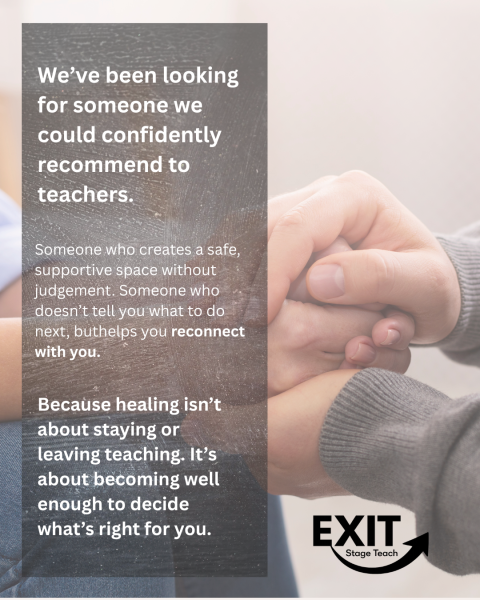
That’s not something we take lightly. For a long time, we’ve known there was one piece missing.
We’ve had career coaches who could help teachers explore new opportunities. We’ve connected our community with resume writers, recruiters and professionals who understand career transition.
But we also knew that wasn’t enough. Because sometimes the next step isn’t updating your resume. Sometimes the next step is taking care of yourself. Over the years, one message has come through again and again from our community. Many of you weren’t just looking for career advice. You were looking for someone who could help you process everything you’d been carrying long before you ever updated your resume. For a long time, we’ve been searching for someone we could confidently recommend to teachers who simply needed a safe place to land. Someone who wasn’t focused on careers or job titles, but on helping people reconnect with themselves after years of carrying more than anyone should have to carry.
We weren’t looking for someone to tell teachers whether they should stay or leave. We were looking for someone who could help them become well enough to make that decision for themselves.
Then we met Susan.
What stood out wasn’t a list of qualifications or a long list of services. It was the way she spoke about people. There was no judgement. No pressure to have everything figured out. No suggestion that anyone needed to be “fixed.”
Instead, there was genuine compassion, deep listening and a belief that healing begins by creating a space where people finally feel safe enough to put down what they’ve been carrying.
That resonated with us immediately. Because that’s exactly what we’ve seen so many teachers needing.
Susan’s approach is different. She understands that emotional wellbeing isn’t simply about learning to cope better. Through her holistic counselling sessions, retreats and wellbeing workshops, she creates space for women to process difficult experiences, rebuild confidence, reconnect with themselves and gently move towards healing in a way that feels safe, deeply personal and completely free from judgement. Every person’s journey is different, which is why Susan’s work is never about offering quick fixes or one-size-fits-all solutions. Whether someone needs the support of individual counselling, the opportunity to step away and reset through a retreat, or the connection and shared experience that comes from learning alongside others in a workshop, her focus is always the same: helping women reconnect with themselves with compassion, curiosity and care.
Some teachers who read this article will decide it’s time to explore a new career. Others will decide to stay in the classroom.
But before either of those decisions, there are teachers who simply need someone to sit beside them for a while and remind them that they don’t have to carry all of this on their own.
We genuinely believe Susan is one of those people.
If you’ve found yourself recognising pieces of your own story throughout this article, we’d encourage you to spend some time exploring Susan’s work. Not because we think everyone needs counselling, and certainly not because we believe there’s one answer that suits everyone, but because we know how powerful it can be to finally feel heard, supported and understood.
Sometimes the most important step forward isn’t making a decision. Sometimes it’s giving yourself permission to heal first.
If you’ve recognised yourself anywhere in this article, we encourage you to take a look at Susan’s work. Read about her approach, explore the counselling sessions, retreats and workshops she offers, and see whether it feels like the right fit for where you are right now. Whether you decide to stay in teaching, leave the classroom or simply take some time to heal, we hope this article reminds you of one thing above all else. You don’t have to carry it alone!
Home